Una nueva prueba ELISA indirecta para La vigilancia serológica del adenovirus aviar en pollos: Uso de una cepa de campo con relevancia regional
Resumen
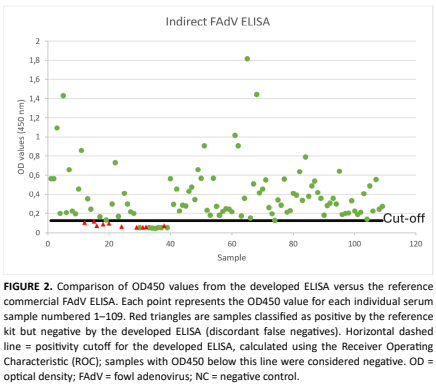
Los adenovirus aviares son importantes patógenos que causan considerables pérdidas económicas a nivel mundial y que están asociados a enfermedades como la hepatitis por cuerpos de inclusión, el síndrome de hidropericardio y la erosión de molleja. Existe una necesidad crítica de herramientas de diagnóstico rápidas, sensibles y de alto rendimiento para la vigilancia seroepidemiológica y la evaluación de la eficacia de las vacunas, ya que los métodos de diagnóstico tradicionales son limitados debido a la gran diversidad viral, lo que a menudo dificulta la eficacia de los ELISA comerciales específicos para cada grupo, puesto que los antígenos pueden no coincidir con los serotipos prevalentes en la región. Este estudio detalla el desarrollo y la validación de un ELISA indirecto diseñado para la detección de anticuerpos frente a los adenovirus aviares en pollos, utilizando un antígeno derivado de una cepa de campo de adenovirus aviares-E de Turquía y propagada en cultivo celular. El ensayo se validó utilizando 109 muestras de suero, comparadas con el kit comercial BioCheck adenovirus aviares-1 ELISA CK132. La prueba desarrollada demostró una dilución óptima de la muestra de 1:400 y un valor de corte de 0,125. Alcanzó una sensibilidad del 90,20 % y una especificidad del 100 %. Un índice kappa de Cohen de 0,675 indicó una buena concordancia con el método de referencia. Además, el ensayo mostró una buena precisión, con coeficientes de variación intraensayo (CV %) que oscilaron entre el 6,24 % y el 11,03 % y un CV % interensayo del 16,20 %, ambos dentro de los límites aceptables. Este novedoso ELISA, que emplea una cepa de campo relevante a nivel regional, ofrece una herramienta específica y eficiente con relación al coste para la vigilancia serológica del adenovirus aviar y el seguimiento de la vacunación, lo que resulta especialmente beneficioso en regiones donde las cepas circulantes varían con respecto a las cepas de las vacunas.
Descargas
Citas
Fitzgerald SD, Rautenschlein S, Mahsoub HM, Pierson FW, Reed WM, Jack SW. Adenovirus infections. In: Swayne DE, Boulianne M, Logue CM, McDougald LR, Nair V, Suarez DL, Wit S, Grimes T, Johnson D, Kromm M, Prajitno TY, Rubinoff I, Zavala G, editors. Diseases of Poultry. 14th edition. Hoboken (NJ): John Wiley & Sons; 2020. p. 321-363. doi: https://doi.org/qwgv
Hess M. Detection and differentiation of avian adenoviruses: a review. Avian Pathol. [Internet]. 2000; 29(3):195-206. doi: https://doi.org/bbzhjs DOI: https://doi.org/10.1080/03079450050045440
Harrach B, Benkő M. Adenoviruses (Adenoviridae). In: Bamford DH, Zuckerman M, editors. Encyclopedia of Virology (4th ed). Oxford (UK): Academic Press; 2021 [cited 20 Aug 2025]. p. 3-16. Available in: https://goo.su/dplSNtO DOI: https://doi.org/10.1016/B978-0-12-814515-9.00057-6
Sohaimi NM, Hair-Bejo M. A recent perspective on fiber and hexon genes proteins analyses of fowl adenovirus toward virus infectivity—A review. Open Vet. J. 2021; 11(4):569-580. doi: https://doi.org/g8p8fj DOI: https://doi.org/10.5455/OVJ.2021.v11.i4.6
Huang J, Tan D, Wang Y, Liu C, Xu J, Wang J. Egg drop syndrome virus enters duck embryonic fibroblast cells via clathrin-mediated endocytosis. Virus Res. [Internet]. 2015; 210:69-76. doi: https://doi.org/f7z26k DOI: https://doi.org/10.1016/j.virusres.2015.07.014
Matczuk AK, Niczyporuk JS, Kuczkowski M, Woźniakowski G, Nowak M, Wieliczko A. Whole genome sequencing of Fowl aviadenovirus A - a causative agent of gizzard erosion and ulceration, in adult laying hens. Infec. Genet. Evol. [Internet]. 2017; 48:47-53. doi: https://doi.org/f9x4pz DOI: https://doi.org/10.1016/j.meegid.2016.12.008
Morshed R, Hosseini H, Langeroudi AG, Fard MHB, Charkhkar S. Fowl Adenoviruses D and E cause inclusion body hepatitis outbreaks in broiler and broiler breeder pullet flocks. Avian Dis. [Internet]. 2017; 61(2):205-210. doi: https://doi.org/g8hcsp DOI: https://doi.org/10.1637/11551-120516-Reg.1
Pan Q, Wang J, Gao Y, Cui H, Liu C, Qi X, Zhang Y, Wang Y, Li K, Gao L, Wang X. Development and application of a novel ELISA for detecting antibodies against group I fowl adenoviruses. Appl. Microbiol. Biotechnol. [Internet]. 2020; 104:853-859. doi: https://doi.org/qwgw DOI: https://doi.org/10.1007/s00253-019-10208-3
Feichtner F, Schachner A, Berger E, Hess M. Fiber-based fluorescent microsphere immunoassay (FMIA) as a novel multiplex serodiagnostic tool for simultaneous detection and differentiation of all clinically relevant fowl adenovirus (FAdV) serotypes. J. Immunol. Methods. [Internet]. 2018; 458:33-43. doi: https://doi.org/gdqrz2 DOI: https://doi.org/10.1016/j.jim.2018.03.002
Şahindokuyucu İ, Çöven F, Kılıç H, Yılmaz Ö, Kars M, Yazıcıoğlu Ö, Ertunç E, Yazıcı Z. First report of fowl aviadenovirus serotypes FAdV-8b and FAdV-11 associated with inclusion body hepatitis in commercial broiler and broiler-breeder flocks in Turkey. Arch. Virol. [Internet]. 2020; 165:43-51. doi: https://doi.org/qwgx DOI: https://doi.org/10.1007/s00705-019-04449-w
Cizmecigil UY, Umar S, Yilmaz A, Bayraktar E, Turan N, Tali B, Aydin O, Tali HE, Yaramanoglu M, Yilmaz SG, Kolukisa A, Sadeyen JR, Iqbal M, Yilmaz H. Characterization of fowl adenovirus (FAdV-8b) strain concerning the geographic analysis and pathological lesions associated with inclusion body hepatitis in broiler flocks in Turkey. J. Vet. Res. [Internet]. 2020; 64(2):231-237. doi: https://doi.org/qwgz DOI: https://doi.org/10.2478/jvetres-2020-0026
Günes A, Marek A, Grafl B, Berger E, Hess M. Real-time PCR assay for universal detection and quantitation of all five species of fowl adenoviruses (FAdV-A to FAdV-E). J. Virol. Methods. [Internet]. 2012; 183(2):147-153. doi: https://doi.org/f32kw4 DOI: https://doi.org/10.1016/j.jviromet.2012.04.005
Pan Q, Wang J, Gao Y, Cui H, Liu C, Qi X, Zhang Y, Wang Y, Wang X. Identification of two novel fowl adenovirus C-specific B cell epitopes using monoclonal antibodies against the capsid hexon protein. Appl. Microbiol. Biotechnol. [Internet]. 2018; 102(21):9243-9253. doi: https://doi.org/gfmjz3 DOI: https://doi.org/10.1007/s00253-018-9262-4
Yuan XY, Wang YL, Meng K, Zhang YX, Xu HY, Ai W. LAMP real-time turbidity detection for fowl adenovirus. BMC Vet. Res. [Internet]. 2019; 15(1):256. doi: https://doi.org/qwg2 DOI: https://doi.org/10.1186/s12917-019-2015-5
Li PH, Zheng P, Zhang TF, Wen GP, Shao H, Luo Q. Fowl adenovirus serotype 4: Epidemiology, pathogenesis, diagnostic detection, and vaccine strategies. Poultry Sci. [Internet]. 2017; 96(8):2630-2640. doi: https://doi.org/gbrjgn DOI: https://doi.org/10.3382/ps/pex087
Rajasekhar R, Roy P. Recombinant hexon antigen based single serum dilution ELISA for rapid serological profiling against fowl adenovirus-4 causing hydropericardium syndrome in chickens. J. Virol. Methods. [Internet]. 2014; 207:121-127. doi: https://doi.org/f6h8vx DOI: https://doi.org/10.1016/j.jviromet.2014.06.017
Ather F, Zia MA, Habib M, Shah MS. Development of an ELISA for the detection of fowl adenovirus serotype-4 utilising fiber protein. Biologicals. [Internet]. 2024; 85:101752. doi: https://doi.org/qwg3 DOI: https://doi.org/10.1016/j.biologicals.2024.101752
Lim SY, Bauermeister A, Kjonaas RA, Ghosh SK. Phytol-based novel adjuvants in vaccine formulation: 2. Assessment of efficacy in the induction of protective immune responses to lethal bacterial infections in mice. J. Immune Based Therap. Vaccines. [Internet]. 2006; 4:5. doi: https://doi.org/dtcjsv DOI: https://doi.org/10.1186/1476-8518-4-5
Kumar S, Chaturvedi V, Kumar B, Kumar P, Somarajan S, Kumar A, Yadav A, Sharma B. Improved humoral immune response of oil adjuvant vaccine by saponin coadjuvantation against haemorrhagic septicaemia in mice and buffalo calves. Indian J. Anim. Sci. [Internet]. 2012; 82(9):953-957. doi: https://doi.org/qwg4 DOI: https://doi.org/10.56093/ijans.v82i9.23644
Sayin Z, Erganiş O. Diagnosis of bovine tuberculosis by PPD-ELISA and sonication-ELISA. Isr. J. Vet. Med. [Internet]. 2013 [cited 23 Sept 2025]; 68(3):180-184. Available in: https://goo.su/OCxhI
Erganiş O, Hadimli HH, Kav K, Sakmanoğlu A, Sayın Z, Pınarkara Y. Farelerde ve koyunlarda inaktif Corynebacterium pseudotuberculosis aşısının kazeöz lenfadenitise karşı etkinliği. Eurasian J Vet Sci. [Internet]. 2014 [cited 22 Sept 2025]; 30(2):72-79. Available in: https://goo.su/XQfT48t
Ferrero I, Dewilde S, Poletti P, Canepa B, Giachino E, Dall’Ara P, Filipe J. Development of a new indirect ELISA test for the detection of anti-Feline Coronavirus antibodies in cats. Vet. Sci. [Internet]. 2025; 12(3):245. doi: https://doi.org/qwg5 DOI: https://doi.org/10.3390/vetsci12030245
Yuan F, Chen C, Covaleda LM, Martins M, Reinhart JM, Sullivan DR, Diel DG, Fang Y. Development of monoclonal antibody-based blocking ELISA for detecting SARS-CoV-2 exposure in animals. mSphere. [Internet]. 2023; 8(4):e00067-23. doi: https://doi.org/qwg6 DOI: https://doi.org/10.1128/msphere.00067-23
Zheng Z, Houchins D, Ung J, Richard JL. Validation of an ELISA test kit for the detection of deoxynivalenol in several food commodities. JSM Mycotoxins. [Internet]. 2003; 2003(Suppl 3):295-302. doi: https://doi.org/qwg7 DOI: https://doi.org/10.2520/myco1975.2003.Suppl3_295
Mei L, Wu P, Ye J, Gao G, Shao L, Huang S, Li Y, Yang X, Chen H, Cao S. Development and application of an antigen capture ELISA assay for diagnosis of Japanese encephalitis virus in swine, human and mosquito. Virol. J. [Internet]. 2012; 9:4. doi: https://doi.org/fx74kk DOI: https://doi.org/10.1186/1743-422X-9-4
Appeltrath GA, Parreuter J, Lindemann M, Klump H, Karsten CB. An efficient ELISA protocol for measurement of SARS-CoV-2 spike-specific IgG in human plasma and serum samples. MethodsX. [Internet]. 2024; 12:102596. doi: https://doi.org/qwg8 DOI: https://doi.org/10.1016/j.mex.2024.102596
Kovařčík K. The development and application of an indirect ELISA test for the detection of antibodies to bovine respiratory syncytial virus in blood serum. Vet. Med. Czech. [Internet]. 2001; 46(2):29-34. doi: https://doi.org/qwg9 DOI: https://doi.org/10.17221/7848-VETMED
Villanueva-Saz S, Basurco A, Martín V, Fernández A, Loste A, Verde MT. Comparison of a qualitative immunochromatographic test with two quantitative serological assays for the detection of antibodies to Leishmania infantum in dogs. Acta Vet. Scand. [Internet]. 2019; 61:38. doi: https://doi.org/qwhb DOI: https://doi.org/10.1186/s13028-019-0473-1
Shao H, Wang P, Wang W, Zhang J, Li T, Liang G, Gao W, Qin A, Ye J. A novel monoclonal antibodies-based sandwich ELISA for detection of serotype 4 fowl adenovirus. Avian Pathol. [Internet]. 2019; 48(3):204-208. doi: https://doi.org/qwhc DOI: https://doi.org/10.1080/03079457.2019.1566595
Lee JW, Devanarayan V, Barrett YC, Weiner R, Allinson J, Fountain S, Keller S, Weinryb I, Green M, Duan L, Rogers JA, Millham R, O’Brien PJ, Sailstad JM, Khan MN, Ray C, Wagner JA. Fit-for-purpose method development and validation for successful biomarker measurement. Pharm. Res. [Internet]. 2006; 23(2):312-328. doi: https://doi.org/fp296j DOI: https://doi.org/10.1007/s11095-005-9045-3
Kelley M, DeSilva B. Key elements of bioanalytical method validation for macromolecules. AAPS J. [Internet]. 2007; 9(2):17. doi: https://doi.org/cm9wqt DOI: https://doi.org/10.1208/aapsj0902017
Lexmond WS, Mee JVD, Ruiter F, Platzer B, Stary G, Yen EH, Dehlink E, Nurko S, Fiebiger E. Development and validation of a standardised ELISA for the detection of soluble Fc-epsilon-RI in human serum. J. Immunol. Methods. [Internet]. 2011; 373(1-2):192-199. doi: https://doi.org/cpt3kc DOI: https://doi.org/10.1016/j.jim.2011.08.018
Varotto-Boccazzi I, Manenti A, Dapporto F, Gourlay LJ, Bisaglia B, Gabrieli P, Forneris F, Faravelli S, Bollati V, Rubolini D, Zuccotti G, Montomoli E, Epis S, Bandi C. Epidemic preparedness—Leishmania tarentolae as an easy-to-handle tool to produce antigens for viral diagnosis: application to COVID-19. Front. Microbiol. [Internet]. 2021; 12:736530. doi: https://doi.org/qwhd DOI: https://doi.org/10.3389/fmicb.2021.736530
Valero MA, Periago MV, Pérez-Crespo I, Rodríguez E, Perteguer MJ, Gárate T, González-Barberá EM, Mas-Coma S. Assessing the validity of an ELISA test for the serological diagnosis of human fascioliasis in different epidemiological situations. Trop. Med. Int. Health. [Internet]. 2012; 17(5):630-636. doi: https://doi.org/dm8c DOI: https://doi.org/10.1111/j.1365-3156.2012.02964.x
Lu H, Wang W, Zhang J, Shao H, Li L, Li T, Xie Q, Wan Z, Qin A, Ye J. An efficient fiber-based ELISA for detection of antibody against fowl adenovirus serotypes 7 and 8. J. Vet. Diagn. Invest. [Internet]. 2020; 32(3):444-449. doi: https://doi.org/qwhf DOI: https://doi.org/10.1177/1040638720913354
Junnu S, Lertwatcharasarakul P, Jala S, Phattanakunanan S, Moonjit P, Songserm T. Developing an indirect ELISA based on recombinant hexon protein for serological detection of inclusion body hepatitis in chickens. J. Vet. Med. Sci. [Internet]. 2014; 76(2):289-293. doi: https://doi.org/f5x3v2 DOI: https://doi.org/10.1292/jvms.13-0196
Hosamani M, Basagoudanavar SH, Tamil-Selvan RP, Das V, Ngangom P, Sreenivasa BP, Hegde R, Venkataramanan R. A multi-species indirect ELISA for detection of non-structural protein 3ABC specific antibodies to foot-and-mouth disease virus. Arch. Virol. [Internet]. 2015; 160(4):937–944. doi: https://doi.org/f65jjp DOI: https://doi.org/10.1007/s00705-015-2339-9
Calnek BW, Shek WR, Menendez NA, Stiube P. Serological cross-reactivity of Avian Adenovirus serotypes in an enzyme-linked immunosorbent assay. Avian. Dis. [Internet]. 1982; 26(4):897-906. doi: https://doi.org/b22rtt DOI: https://doi.org/10.2307/1589878