Efecto de la administración de Limosilactobacillus reuteri vivo o muerto por calor en los niveles de algunos antioxidantes y citocinas en la suero de ratas expuestas al cadmio
Resumen
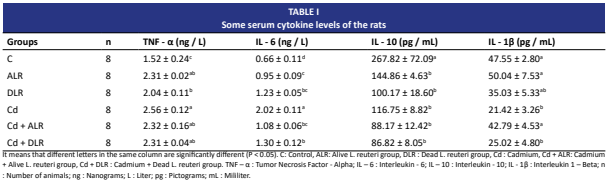
El propósito de este estudio fue examinar cómo la administración de Limosilactobacillus reuteri (L. reuteri), ya sea en su forma viva o muerta por calor, influye sobre los niveles de ciertos antioxidantes y citocinas en la sangre de ratas expuestas a la toxicidad crónica del cadmio. Para ello, se separó aleatoriamente a las ratas (n = 48) en seis grupos homogéneos : cadmio, L. reuteri vivo, cadmio + L. reuteri vivo, L. reuteri muerto, cadmio + L. reuteri muerto y grupo de control. Se administró cadmio por vía oral a los grupos cadmio, cadmio + L. reuteri vivo y cadmio + L. reuteri muerto tres veces por semana durante cuatro semanas. Se dio L. reuteri, ya sea vivo o muerto por calor, por vía oral a los grupos L. reuteri vivo, L. reuteri muerto, cadmio + L. reuteri vivo y cadmio + L. reuteri muerto durante el mismo tiempo. Tras el periodo de tratamiento, se obtuvieron muestras de suero de los animales. Se estudiaron los niveles de cadmio y glutatión peroxidasa en la sangre, así como las actividades de las enzimas catalasa y superóxido dismutasa. Se evaluaron también los niveles de malondialdehído (MDA) y los niveles de factor de necrosis tumoral alfa (TNF - α), interleucina - 6 (IL - 6), IL - 10 e IL - 1β. La administración de L. reuteri, ya sea vivo o muerto por calor, redujo la acumulación de cadmio en muestras de suero de los animales de los grupos L. reuteri vivo y L. reuteri muerto (especialmente) en comparación con el cadmio (P < 0,05). La administración de L. reuteri vivo redujo la actividad de la enzima superóxido dismutasa en suero, mientras que, el L. reuteri muerto disminuyó los niveles de glutatión peroxidasa en comparación con el grupo control (P < 0,05). En conclusión, las cepas vivas y muertas de L. reuteri tuvieron diversos efectos protectores sobre los niveles séricos de citocinas en ratas, pero sus efectos sobre los indicadores de estrés oxidativo se limitaron.
Descargas
Citas
Soni S, Jha AB, Dubey RS, Sharma P. Mitigating cadmium accumulation and toxicity in plants: The promising role of nanoparticles. Sci. Total Environ. [Internet]. 2024; 912:168826. doi: https://doi.org/gzwvbd DOI: https://doi.org/10.1016/j.scitotenv.2023.168826
Kubier A, Wilkin RT, Pichler T. Cadmium in soils and groundwater: A review. Appl. Geochem. [Internet]. 2019; 108:104388. doi: https://doi.org/gjks3j DOI: https://doi.org/10.1016/j.apgeochem.2019.104388
Suhani I, Sahab S, Srivastava V, Singh RP. Impact of cadmium pollution on food safety and human health. Curr. Opin. Toxicol. [Internet]. 2021; 27:1-7. doi: https://doi.org/gpwrnw DOI: https://doi.org/10.1016/j.cotox.2021.04.004
Fanfani A, Papini S, Bortolotti E, Vagnoni G, Saieva C, Bonaccorsi G, Caini S. Cadmium in biological samples and site-specific cancer risk and mortality: A systematic review of original original articles and meta-analyses. Cancer Epidemiol. [Internet]. 2024; 92:102550. doi: https://doi.org/q6jj DOI: https://doi.org/10.1016/j.canep.2024.102550
Kanwel S, Gulzar F, Alofaysan H, Tanriverdiyev S, Jing H. Toxic metal pollution in freshwater ecosystems: A systematic review of assessment methods using environmental and statistical indices. Mar. Pollut. Bull. [Internet]. 2025; 218:118028. doi: https://doi.org/q6jk DOI: https://doi.org/10.1016/j.marpolbul.2025.118028
Nordberg M, Nordberg GF. Metallothionein and cadmium toxicology-historical review and commentary. Biomolecules. [Internet]. 2022; 12(3):360. doi: https://doi.org/gpm2vz DOI: https://doi.org/10.3390/biom12030360
Fiati-Kenston SS, Su H, Li Z, Kong L, Wang Y, Song X, Gu Y, Barber T, Aldinger J, Hua Q, Li Z, Ding M, Zhao J, Lin X. The systemic toxicity of heavy metal mixtures in rats. Toxicol. Res. [Internet]. 2018; 7(3):396-407. doi: https://doi.org/q6jm DOI: https://doi.org/10.1039/C7TX00260B
Park E, Kim J, Kim B, Park EY. Association between environmental exposure to cadmium and risk of suspected non-alcoholic fatty liver disease. Chemosphere. [Internet]. 2021; 266:128947. doi: https://doi.org/gkkzmg DOI: https://doi.org/10.1016/j.chemosphere.2020.128947
Tan LL, Xiong YW, Zhang J, Li DX, Huang Y, Wang H. Like father, like daughter: Paternal cadmium exposure causes hepatic glucose metabolic disorder and phospholipids accumulation in adult female offspring. Chemosphere. [Internet]. 2023; 338:139437. doi: https://doi.org/gzk6n2 DOI: https://doi.org/10.1016/j.chemosphere.2023.139437
Verzelloni P, Urbano T, Wise LA, Vinceti M, Filippini T. Cadmium exposure and cardiovascular disease risk: A systematic review and dose-response meta-analysis. Environ. Pollut. [Internet]. 2024; 345:123462. doi: https://doi.org/q6jp DOI: https://doi.org/10.1016/j.envpol.2024.123462
Hernández-Cruz EY, Arancibia-Hernández YL, Loyola-Mondragón DY, Pedraza-Chaverri J. Oxidative stress and its role in Cd-induced epigenetic modifications: Use of antioxidants as a possible preventive strategy. Oxygen. [Internet]. 2022; 2(2):177-210. doi: https://doi.org/q6jq DOI: https://doi.org/10.3390/oxygen2020015
Solleiro-Villavicencio H, Rivas-Arancibia S. Effect of chronic oxidative stress on neuroinflammatory response mediated by CD4+ T cells in neurodegenerative diseases. Front. Cell. Neurosci. [Internet]. 2018; 12:114. doi: https://doi.org/gdjpfp DOI: https://doi.org/10.3389/fncel.2018.00114
Goyal T, Mitra P, Singh P, Sharma P, Sharma S. Evaluation of oxidative stress and pro-inflammatory cytokines in occupationally cadmium exposed workers. Work. [Internet]. 2021; 69(1):67-73. doi: https://doi.org/q6jr DOI: https://doi.org/10.3233/WOR-203302
Das U.N. Inflammation. In: Molecular Basis of Health and Disease. Dordrecht: Springer; 2011. doi: https://doi.org/cc26qn DOI: https://doi.org/10.1007/978-94-007-0495-4_3
Olszowski T, Baranowska-Bosiacka I, Gutowska 1, Chlubek D. Pro-inflammatory properties of cadmium. Acta Biochim. Pol. [Internet]. 2012; 59(4):475-482. doi: https://doi.org/g9m3k5 DOI: https://doi.org/10.18388/abp.2012_2080
Sengul E, Yildirim S, Cinar I, Tekin S, Dag Y, Bolat M, Gok M, Warda M. Mitigation of acute hepatotoxicity induced by cadmium through morin: Modulation of oxidative and pro-apoptotic endoplasmic reticulum stress and inflammatory responses in rats. Biol. Trace Elem. Res. [Internet]. 2024; 202:5106-5117. doi: https://doi.org/q6js DOI: https://doi.org/10.1007/s12011-024-04064-0
Kisadere I, Karaman M, Aydin MF, Donmez N, Usta M. The protective effects of chitosan oligosaccharide (COS) on cadmium-induced neurotoxicity in Wistar rats. Arch. Environ. Occup. Health. [Internet]. 2022; 77(9):755-763. doi: https://doi.org/q5rp DOI: https://doi.org/10.1080/19338244.2021.2008852
Abd El-Aziz NM, Badr AN, Farrage EA, Darwish AMG, Shehata MG. Cadmium toxicity alleviation in rats using Lactobacillus-fermented and unfermented Opuntia ficus-indica L. juices. Toxicol. Rep. [Internet]. 2025; 15:102089. doi: https://doi.org/q6jw DOI: https://doi.org/10.1016/j.toxrep.2025.102089
Xie Y, Fan J, Zhu W, Amombo E, Lou Y, Chen L, Fu J. Effect of heavy metals pollution on soil microbial diversity and Bermudagrass genetic variation. Front. Plant Sci. [Internet]. 2016; 7:755. doi: https://doi.org/gn5g9x DOI: https://doi.org/10.3389/fpls.2016.00755
Xu Y, Shu G, Liu Z, Wang Z, Lei H, Zheng Q, Kang H, Chen L. Preliminary study on screening and genetic characterization of lactic acid bacteria strains with cadmium, lead, and chromium removal potentials. Fermentation. [Internet]. 2024; 10(1):41. doi: https://doi.org/q6jz DOI: https://doi.org/10.3390/fermentation10010041
Ma X. Heavy metals remediation through lactic acid bacteria: Current status and future prospects. Sci. Total Environ. [Internet]. 2024; 946:174455. doi: https://doi.org/g94znd DOI: https://doi.org/10.1016/j.scitotenv.2024.174455
Güner TE, Akyol BA, Tavsanli H, Gokbulut C. Effects of different inactivation and activation treatments applied to lactic acid bacteria on AFM1 detoxification in milk. Food Biosci. [Internet]. 2025; 69:106974. doi: https://doi.org/qt7f DOI: https://doi.org/10.1016/j.fbio.2025.106974
Banwo K, Alonge Z, Sanni Al. Binding capacities and antioxidant activities of Lactobacillus plantarum and Pichia kudriavzevii against ainst cadm cadmium and lead toxicities. Biol. Trace Elem. Res. [Internet]. 2021; 199(2):779-791. doi: https://doi.org/ghfmp8 DOI: https://doi.org/10.1007/s12011-020-02164-1
Baralić K, Živančević K, Bozić D, Đukić-Ćosić D. Probiotic cultures as a potential protective strategy against the toxicity of environmentally relevant chemicals: State-of-the-art knowledge. Food Chem. Toxicol. [Internet]. 2023; 172:113582. doi: https://doi.org/q6j3 DOI: https://doi.org/10.1016/j.fct.2022.113582
Kisadere I, Güner B, Tavsanli H, Aydin MF, Usta M. Influence of Lactobacillus plantarum administration on some serum/tissue (uterus) antioxidant and cytokine levels in female rats exposed to cadmium (Cd). Turk. J. Vet. Anim. Sci. [Internet]. 2023; 47(3):270-280. doi: https://doi.org/qpgp DOI: https://doi.org/10.55730/1300-0128.4294
Sgritta M, Dooling SW, Buffington SA, Momin EN, Francis MB, Britton RA, Costa-Mattioli M. Mechanisms underlying microbial-mediated changes in social behavior in mouse models of autism spectrum disorder. Neuron. [Internet]. 2019; 101(2):246-259.e6. doi: https://doi.org/gfkr49 DOI: https://doi.org/10.1016/j.neuron.2018.11.018
Kubota M, Ito K, Tomimoto K, Kanazaki M, Tsukiyama K, Kubota A, Kuroki H, Fujita M, Vandenplas Y. Lactobacillus reuteri DSM 17938 and magnesium oxide in children with functional chronic constipation: A double-blind and randomized clinical trial. Nutrients. [Internet]. 2020; 12(1):225. doi: https://doi.org/gtzt9 DOI: https://doi.org/10.3390/nu12010225
Dargenio C, Dargenio VN, Bizzoco F, Indrio F, Francavilla R, Cristofori F. Limosilactobacillus reuteri strains as adjuvants in the management of Helicobacter pylori infection. Medicina. [Internet]. 2021; 57(7):733. doi: https://doi.org/gqtwq9 DOI: https://doi.org/10.3390/medicina57070733
Sajjad A, Ali S, Mumtaz S, Summer M, Farooq MA, Hassan A. Chemoprotective and immunomodulatory potential of Lactobacillus reuteri against cadmium chloride-induced breast cancer in mice. J. Infect. Chemother. [Internet]. 2024; 30(9):838–846. doi: https://doi.org/q6j4 DOI: https://doi.org/10.1016/j.jiac.2024.02.023
Zhai Q, Xiao Y, Zhao J, Tian F, Zhang H, Narbad A, Chen W. Identification of key proteins and pathways in cadmium tolerance of Lactobacillus plantarum strains by roteomic analysis. Sci. Rep. [Internet]. 2017; 7:1182. doi: https://doi.org/f97ch5 DOI: https://doi.org/10.1038/s41598-017-01180-x
Daisley BA, Monachese M, Trinder M, Bisanz JE, Chmiel JA, Burton JP, ReidG. Immobilization of cadmium and lead by Lactobacillus rhamnosus GR-1 mitigates apical-to-basolateral heavy metal translocation in a Caco-2 model of the intestinal epithelium. Gut Microbes. [Internet]. 2019; 10(3):321-333. doi: https://doi.org/gstdxh DOI: https://doi.org/10.1080/19490976.2018.1526581
Gerbino E, Carasi P, Tymczyszyn EE, Gómez-Zavaglia A. Removal of cadmium by Lactobacillus kefir as a protective tool against toxicity. J. Dairy Res. [Internet]. 2014; 81(3):280-287. doi: https://doi.org/f6ct3t DOI: https://doi.org/10.1017/S0022029914000314
Zhai Q, Wang G, Zhao J, Liu X, Narbad A, Chen YQ, Zhang H, Tian F, Chen W. Protective effects of Lactobacillus plantarum CCFM8610 against chronic cadmium toxicity in mice indicate routes of protection besides intestinal sequestration. Appl. Environ. Microbiol. [Internet]. 2014; 80(13):4063-4071. doi: https://doi.org/f56mzh DOI: https://doi.org/10.1128/AEM.00762-14
Almenara CC, Broseghini-Filho GB, Vescovi MV, Angeli JK, Faria T de O, Stefanon I, Vassallo DV, Padilha AS. Chronic cadmium treatment promotes oxidative stress and endothelial damage in isolated rat aorta. PLoS One. [Internet]. 2013; 8(7):e68418. doi: https://doi.org/f5bscs DOI: https://doi.org/10.1371/journal.pone.0068418
Wardani GM, Sudjarwo SA. Immunostimulatory activity of chitosan nanoparticles on Wistar albino rats. Pharmacogn. J. [Internet]. 2018; 10(5):892-898. doi: https://doi.org/q6nc DOI: https://doi.org/10.5530/pj.2018.5.150
Altundag H, Tuzen M. Comparison of dry, wet and microwave digestion methods for the multi element determination in some dried fruit samples by ICP-OES. Food Chem. Toxicol. [Internet]. 2011; 49(11):2800-2807. doi: https://doi.org/fkzh3q DOI: https://doi.org/10.1016/j.fct.2011.07.064
Tokay F, Bağdat S. Schiff base functionalized silica gel for simultaneous separation and preconcentration of Cu(II), Ni(II), and Cd(II) in pharmaceuticals and water samples. Turk. J. Chem. [Internet]. 2022; 46(2):459-474. doi: https://doi.org/q6nd DOI: https://doi.org/10.55730/1300-0527.3320
De Conti A, Madia F, Schubauer-Berigan MK, Benbrahim-Tallaa L. Carcinogenicity of some metals evaluated by the IARC Monographs: A synopsis of the evaluations of arsenic, cadmium, cobalt, and antimony. Toxicol. Appl. Pharmacol. [Internet]. 2025; 504:117506. doi: https://doi.org/g6nf DOI: https://doi.org/10.1016/j.taap.2025.117506
Andjelkovic M, Buha-Djordjevic A, Antonijevic E, Antonijevic B, Stanic M, Kotur-Stevuljevic J, Spasojevic-Kalimanovska V, Jovanovic M, Boricic N, Wallace D, Bulat Z. Toxic effect of acute cadmium and lead exposure in rat blood, liver, and kidney. Int. J. Environ. Res. Public Health. [Internet]. 2019; 16(2):274. doi: https://doi.org/qpgs DOI: https://doi.org/10.3390/ijerph16020274
Zhai Q, Liu Y, Wang C, Zhao J, Zhang H, Tian F, Lee YK, Chen W. Increased cadmium excretion due to oral administration of Lactobacillus plantarum strains by regulating enterohepatic circulation in mice. J. Agric. Food Chem. [Internet]. 2019; 67(14):3956-3965. doi: https://doi.org/qt7j DOI: https://doi.org/10.1021/acs.jafc.9b01004
Kisadere I. The effects of melatonin treatment on some serum immunoregulatory cytokine levels in rats exposed to chronic cadmium toxicity. Kocatepe Vet. J. [Internet]. 2020 [cited 20 Dec 2025]; 13(3):262-266. Available in: https://goo.su/xbqdwZi
Wang MJ, Zhang HL, Chen F, Guo XJ, Liu QG, Hou J. The double-edged effects of IL-6 in liver regeneration, aging, inflammation, and diseases. Exp. Hematol. Oncol. [Internet]. 2024; 13:62. doi: https://doi.org/q6nh DOI: https://doi.org/10.1186/s40164-024-00527-1
Wu D, Gong Z, Hao X, Liu L. Genetic perturbation of IL-6 receptor signaling pathway and risk of multiple respiratory diseases. J. Transl. Med. [Internet]. 2024; 22:581. doi: https://doi.org/g94h44 DOI: https://doi.org/10.1186/s12967-024-05366-6
Kataranovski M, Janković S, Kataranovski D, Stošić J, Bogojević D. Gender differences in acute cadmium-induced systemic inflammation in rats. Biomed. Environ. Sci. [Internet]. 2009; 22(1):1-7. doi: https://doi.org/bqxfhr DOI: https://doi.org/10.1016/S0895-3988(09)60014-3
El-Boshy ME, Risha EF, Abdelhamid FM, Mubarak MS, Hadda TB. Protective effects of selenium against cadmium induced hematological disturbances, immunosuppressive, oxidative stress and hepatorenal damage in rats. J. Trace Elem. Med. Biol. [Internet]. 2015; 29:104-110. doi: https://doi.org/f6vwtg DOI: https://doi.org/10.1016/j.jtemb.2014.05.009
Li M, Yan Q, Chen C, Hu T, Yin H, Zhao L, Shi F, Ye G, Yin L, Liang X, Li Y, Tang H. Epigallocatechin-3-gallate mitigates cadmium-induced intestinal damage through modulation of the microbiota-tryptophan-aryl hydrocarbon receptor pathway. Ecotoxicol. Environ. Saf. [Internet]. 2024; 280:116520. doi: https://doi.org/q6nj DOI: https://doi.org/10.1016/j.ecoenv.2024.116520
Li Y, Wang S, Feng R. Dietary selenium mitigates cadmium-induced apoptosis and inflammation in chicken testicles by inhibiting oxidative stress through the activation of the Nrf2/HO-1 signaling pathway. Poult. Sci. [Internet]. 2025; 104(4):104990. doi: https://doi.org/q6nk DOI: https://doi.org/10.1016/j.psj.2025.104990
Tian X, Yu Z, Feng P, Ye Z, Li R, Liu J, Hu J, Kakade A, Liu P, Li X. Lactobacillus plantarum TW1-1 alleviates diethylhexylphthalate-induced testicular damage in mice by modulating gut microbiota and decreasing inflammation. Front. Cell. Infect. Microbiol. [Internet]. 2019; 9:221. doi: https://doi.org/q6nm DOI: https://doi.org/10.3389/fcimb.2019.00221
García-Domínguez M. The role of TNF-a in neuropathic pain: an immunotherapeutic perspective. Life [Internet]. 2025; 15(5):785. doi: https://doi.org/g92ssd DOI: https://doi.org/10.3390/life15050785
Narasimhappagari J, Liu L, Balasubramaniam M, Ayyadevara S, Aboud O, Griffin WST. The seminal role of the proinflammatory cytokine IL-1ẞ and its signaling cascade in glioblastoma pathogenesis and the therapeutic effect of interleukin-1ẞ receptor antagonist (IL-1RA) and tolcapone. Int. J. Mol. Sci. [Internet]. 2025; 26(14):6893. doi: https://doi.org/q6nn DOI: https://doi.org/10.3390/ijms26146893
Zhang CY, Ou AJ, Jin L, Yang NS, Deng P, Guan CX, Huang XT, Duan JX, Zhou Y. Cadmium exposure triggers alveolar epithelial cell pyroptosis by inducing mitochondrial oxidative stress and activating the CGAS-STING pathway. Cell Commun. Signal. [Internet]. 2024; 22(1):566. doi: https://doi.org/g9s7pt DOI: https://doi.org/10.1186/s12964-024-01946-7
Zhao L, Liao M, Li L, Chen L, Zhang T, Li R. Cadmium activates the innate immune system through the AIM2 inflammasome. Chem. Biol. Interact. [Internet]. 2024; 399:111122. doi: https://doi.org/g9j8gh DOI: https://doi.org/10.1016/j.cbi.2024.111122
Li H, Liu Y, Zhou J, Liu S, Liu Y, Yang Y, Wang W, Che Y, Inam M, Guan L. The protective mechanism of a novel polysaccharide from Lactobacillus-fermented Nostoc commune Vauch. on attenuating cadmium-induced kidney injury in mice. Int. J. Biol. Macromol. [Internet]. 2023; 226:1444-1454. doi: https://doi.org/q6np DOI: https://doi.org/10.1016/j.ijbiomac.2022.11.256
Carlini V, Noonan DM, Abdalalem E, Goletti D, Sansone C, Calabrone L, Albini A. The multifaceted nature of IL-10: Regulation, role in immunological homeostasis and its relevance to cancer, COVID-19 and post-COVID conditions. Front. Immunol. [Internet]. 2023; 14:1161067. doi: https://doi.org/gsd4g9 DOI: https://doi.org/10.3389/fimmu.2023.1161067
Badawi K, El Sharazly BM, Negm O, Khan R, Carter WG. Is cadmium genotoxicity due to the induction of redox stress and inflammation? A systematic review. Antioxidants. [Internet]. 2024; 13(8):932. doi: https://doi.org/q6nr DOI: https://doi.org/10.3390/antiox13080932
Kara H, Karataş F, Canatan H. Effect of single dose cadmium chloride administration on oxidative stress in male and female rats. Turk. J. Vet. Anim. Sci. [Internet]. 2005 [cited 20 Dec 2025]; 29(1):37-42. doi: https://goo.su/Sp60Lh
Evcimen M, Aslan R, Gulay MS. Protective effects of polydatin and grape seed extract in rats exposed to cadmium. Drug Chem. Toxicol. [Internet]. 2020; 43(3):225-233. doi: https://doi.org/q6ns DOI: https://doi.org/10.1080/01480545.2018.1480629
Galażyn-Sidorczuk M, Brzóśka MM, Rogalska J, Roszczenko A, Jurczuk M. Effect of zinc supplementation on glutathione peroxidase activity and selenium concentration in the serum, liver and kidney of rats chronically exposed to cadmium. J. Trace Elem. Med. Biol. [Internet]. 2012; 26(1):46-52. doi: https://doi.org/d7bd4p DOI: https://doi.org/10.1016/j.jtemb.2011.10.002
Poli V, Madduru R, Aparna Y, Kandukuri V, Motireddy SR. Amelioration of cadmium-induced oxidative damage in Wistar rats by vitamin C, zinc and N-acetylcysteine. Med. Sci. [Internet]. 2022; 10(1):7. doi: https://doi.org/q6nt DOI: https://doi.org/10.3390/medsci10010007
Xue Y, Huang F, Tang R, Fan Q, Zhang B, Xu Z, Sun X, Ruan Z. Chlorogenic acid attenuates cadmium induced intestinal injury in Sprague-Dawley rats. Food Chem. Toxicol. [Internet]. 2019; 133:110751. doi: https://doi.org/qt7p DOI: https://doi.org/10.1016/j.fct.2019.110751
Ognjanović BI, Marković SD, Pavlović SZ, Žikić RV, Stajn AS, Saičić ZS. Effect of chronic cadmium exposure on antioxidant defense system in some tissues of rats: Protective effect of selenium. Physiol. Res. [Internet]. 2008; 57(3):403-411. doi: https://doi.org/q6nv DOI: https://doi.org/10.33549/physiolres.931197
Suhartono E, Triawanti, Leksono AS, Djati MS. Oxidative stress and kidney glycation in rats exposed cadmium. Int. J. Chem. Eng. Appl. [Internet]. 2014; 5(6):497-501. doi: https://doi.org/q6nw DOI: https://doi.org/10.7763/IJCEA.2014.V5.435
Koyuturk M, Yanardag R, Bolkent S, Tunali S. Influence of combined antioxidants against cadmium-induced testicular damage. Environ. Toxicol. Pharmacol. [Internet]. 2006; 21(3):235-240. doi: https://doi.org/c7gx38 DOI: https://doi.org/10.1016/j.etap.2005.08.006
Jihen El H, Imed M, Fatima H, Abdelhamid K. Protective effects of selenium (Se) and zinc (Zn) on cadmium (Cd) toxicity in the liver of the rat: Effects on the oxidative stress. Ecotoxicol. Environ. Saf. [Internet]. 2009; 72(5):1559-1564. doi: https://doi.org/c9w3mp DOI: https://doi.org/10.1016/j.ecoenv.2008.12.006