Nutritional status and reproductive performance of silvopastoral livestock in the Andean region of Ecuador
Abstract
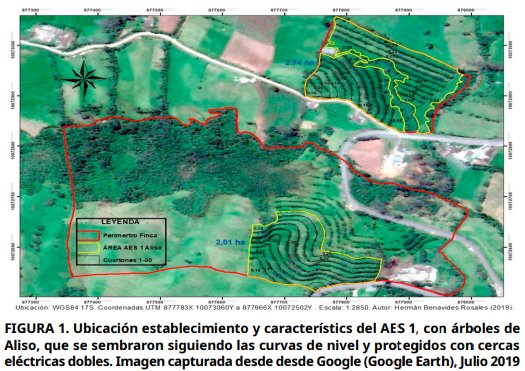
This study was conducted to evaluate the effects of silvopastoral systems with the inclusion of Alnus acuminata H.B.K (Aliso) and Acacia melanoxylon R.Br. (Acacia), in association with the herbaceous stratum, on the nutritional status and reproductive performance of cattle in silvopastoral systems in the Andean region of Ecuador. Agroecosystems 1 and 2 included Aliso and Acacia, respectively, and the agroecosystem 3 included only grasses. Using a multifactorial analysis of variance with interaction, the effect of the agroecosystem and year on body condition at calving and reproductive indicators was determined. Energy deficits were present in the second year of the agroecosystem 1 and 3, and in all three years of the agroecosystem 2. Crude protein levels were excessive in all three agroecosystems in all three years. The calving–first insemination interval was lower (P<0.05) in cows from the agroecosystem 1 and years 2 and 3. The body condition at calving and services per pregnancy were higher (P<0.05) in the agroecosystem 1 and the first year, respectively. The calving–to– conception intervals and calving–to–parturition were shorter in the agroecosystem 1 and in years 2 and 3. It is concluded that in the agroecosystem 1 and 2, alder and acacia favored nutrient balance. In the agroecosystem 1, body condition at calving was higher and the calving–first insemination interval was lower; the interaction between the agroecosystem and year benefited the calving–to–conception intervals and the calving–to–parturition, which were better in the agroecosystem 1, in the third year.
Downloads
References
Benavides–Rosales HR, Mina–Ortega JI, Chamorro– Hernández ML, Coronel–Montesdeoca TN, Ortiz–Tirado SP, García–Díaz JR. Productividad de biomasa comestible y producción láctea en sistemas silvopastoriles de la región andina de Ecuador. Rev. Cientif. FCV–LUZ [Internet]. 2025; 35(2):e35618. doi: https://doi.org/qkjb DOI: https://doi.org/10.52973/rcfcv-e35618
Jayasinghe P, Ramilan, Thiagarajah, Donaghy DJ, Pembleton KG, Barber DG. Comparison of nutritive values of tropical pasture species grown in different environments, and implications for livestock methane production: A meta–analysis. Animals [Internet]. 2022; 12(14):1806. doi: https://doi.org/pjtt DOI: https://doi.org/10.3390/ani12141806
Benavides–Rosales HR, Noval–Artíles E, García–Díaz JR. Efecto de los sistemas silvopastoriles en la corrección del síndrome de la leche anormal en Ecuador. Rev. Prod. Anim. [Internet]. 2024 [accedido 23 Jul. 2025]; 36(3):e159. Disponible en: https://goo.su/sfjSI
Balarezo LR, García–Díaz JR, Hernández–Barreto M, Vargas– Hernández S. Uterine involution in Hosltein cows in the province of Carchi, Ecuador. Rev. MVZ Córdoba [Internet]. 2018; 23(2):6649–6659. doi: https://doi.org/g8m3jb DOI: https://doi.org/10.21897/rmvz.1339
Balarezo–Urresta LR, García–Díaz JR, Noval–Artíles E. Corporal condition and restart of the ovarian postpartum on Holstein cows in Ecuador. Rev. MVZ Córdoba [Internet]. 2020; 25(3):e1859. doi: https://doi.org/g8342w DOI: https://doi.org/10.21897/rmvz.1859
Amorim HCS, Ashworth AJ, O’Brien PL, Thomas AL, Runkle BRK, Philipp D. Temperate silvopastures provide greater ecosystem services than conventional pasture systems. Sci. Rep. [Internet]. 2023; 13(1):18658. doi: https://doi.org/qkjc DOI: https://doi.org/10.1038/s41598-023-45960-0
Thomsen SJ, Poudel S, Fike JH, Pent GJ. Heifer performance and body temperatures in an open pasture versus silvopasture in the mid–Atlantic USA. Agrofor. Syst. [Internet]. 2023; 98:47–59. doi: https://doi.org/qkjd DOI: https://doi.org/10.1007/s10457-023-00889-1
Poudel S, Pent G, Fike J. Silvopastures: benefits, past efforts, challenges, and future prospects in the United States. Agronomy [Internet]. 2024; 14(7):1369. doi: https://doi.org/qkjf DOI: https://doi.org/10.3390/agronomy14071369
Benavides HR, Vargas S, Caicedo D, Carvajal L, Gutiérrez DI, Mina J. Effect of agro–ecosystem and periods of the year upon earthworm population density on silvopastoral systems. Cuban J. Agricul.Sci. [Internet]. 2019 [consulado 12 Dic. 2024]; 53(1):197–206. Disponible en: https://goo.su/S9WviH
Tzec–Gamboa MC, Álvarez–Rivera OO, Ramírez–Avilés L, Solorio–Sánchez FJ. Decomposition and nitrogen release rates of foliar litter from single and mixed agroforestry Species under field conditions. Agriculture [Internet]. 2023; 13(1): 222–238. doi: https://doi.org/pjtv DOI: https://doi.org/10.3390/agriculture13010222
Vargas–Hernández S. Producción de leche bovina tropical sostenible. Diseño, manejo y evaluación de agroecosistemas. Un enfoque integrado. Madrid (España): Editorial académica española; 2013.
Vinoles C, Kássio–Fedrigo J, Benítez–Gonzalez V, García L, Báez F. Advances in knowledge about silvopastoral systems in Uruguay. Arch. Latinoam. Prod. Anim. [Internet]. 2022; 30(Supl. 1):43–53. doi: https://doi.org/g7zbjd DOI: https://doi.org/10.53588/alpa.300505
Arciniegas–Torres SP, Flórez–Delgado DF. Estudio de los sistemas silvopastoriles como alternativa para el manejo sostenible de la ganadería. Cien. Agri. [Internet]. 2018; 15(2):107–116. doi: https://doi.org/qkjg DOI: https://doi.org/10.19053/01228420.v15.n2.2018.8687
Poudel S, Ely K, Fike J. The potential of silvopasture in the mid–atlantic USA: insights from land managers on motivations, challenges, and production features. Agrofor. Syst. [Internet]. 2025; 99(3):52. doi: https://doi.org/qkjh DOI: https://doi.org/10.1007/s10457-025-01145-4
Instituto Nacional de Meteorología e Hidrografía (INAMHI). Datos meteorológicos de la estación meteorológica de Chalpatán, Carchi, Ecuador. Internet [consultado 19 Mar. 2023]. Disponible en: https://goo.su/QUMVxA
Cuesta M, Montejo E, Duvergel J. Medicina Interna Veterinaria. La Habana (Cuba): Editorial Félix Varela; 2007.
Roche A, Larduet R, Torres V, Ajete A. CALRAC: A microcomputer programme for the estimation of ruminant rations. Cuban J. Agric. Sci. [Internet]. 1999 [consultado 22 Dic. 2024]; 33(1):13–19. Disponible en: https://goo.su/io2n
Brito R, Blanco S, Calderón R, Preval B, Campo E. Patología de la reproducción animal. 2da ed. La Habana (Cuba): Editorial Félix Varela; 2010.
French, J, Wright, T, Mongeon, M. Body condition scoring of dairy cattle. [Internet]. 2020 [consultado 20 Ene. 2020]. Disponible en: https://goo.su/9HzfFB
Bonferroni CE. Teoria statistica delle classi e calcolo delle probabilita. Pubblicazioni del R. Istituto superiore di scienze economiche e commerciali di Firenze. Florencia (Italia): Seeber; 1936.
StatPoint Technologies. 2010. Statgraphics Centurion. (ser. Centurion), version 16.1 (XV), [Windows]. [consultado 15 Abr. 2012]. Disponible en: https://goo.su/UptWz
Butler RW. Nutrition and reproduction in transition cows. In: PRO–DAIRY Herd Health and Nutrition Conference; 2019 Abr 4. New York (EUA): Cornell University Library; 2019 [consultado 17 Ago. 2025]. p. 1–10. Disponible en: https://goo.su/dYBoUn
Carvalho WF, Oliveira ME, Alves AA, Moura RL, da Silva–Moura RMA. Energy supplementation in goats under a silvopastoral system of tropical grasses and leucaena. Rev. Ciênc. Agron. [Internet]. 2017; 48(1):199–207. doi: https://doi.org/kp4b DOI: https://doi.org/10.5935/1806-6690.20170023
Kananub S, Pechkerd P, VanLeeuwen J, Stryhn H, Arunvipas P. Evaluation of influence of milk urea nitrogen on reproductive performance in smallholder dairy farms. Aust. Vet. J. [Internet]. 2020; 98(8):375–379. doi: https://doi.org/pjt3 DOI: https://doi.org/10.1111/avj.12946
Barletta RV, Maturana–Filho M, Carvalho PD, Del Valle TA, Netto AS, Rennó FP, Mingoti RD, Gandra JR, Mourão GB, Fricke PM, Sartori R, Madureira EH, Wiltbank MC. Association of changes among body condition score during the transition period with NEFA and BHBA concentrations, milk production, fertility, and health of Holstein cows. Theriogenology [Internet]. 2017; 104:30–36. doi: https://doi.org/qgfb DOI: https://doi.org/10.1016/j.theriogenology.2017.07.030
López O. Influencia del balance de energía en el desempeño productivo y reproductivo de vacas Mambí de Cuba en un sistema silvopastoril [Tesis doctoral]. Mayabeque (Cuba): Universidad Agraria de la Habana; 2023. 53 p.
Gobikrushanth M, Macmillan K, Behrouzi A, Hoff B, Colazo MG. The factors associated with postpartum body condition score change and its relationship with serum analytes, milk production and reproductive performance in dairy cows. Livest. Sci. [Internet]. 2019; 228:151–160. doi: https://doi.org/qkjj DOI: https://doi.org/10.1016/j.livsci.2019.05.016
Carvalho PD, Souza AH, Amundson MC, Hackbart KS, Fuenzalida M.J, Herlihy MM, Ayres H, Dresch AR, Vieira LM, Guenther JN, Grummer RR, Fricke PM, Shaver RD, Wiltbank MC. Relationships between fertility and postpartum changes in body condition and body weight in lactating dairy cows. J. Dairy Sci. [Internet]. 2014; 97(6): 3666–3683. doi: https://doi.org/f54px8 DOI: https://doi.org/10.3168/jds.2013-7809
Robson C, Aller JF, Callejas S, Alberio RH. Dinámica folicular y comportamiento del amamantamiento en razas Angus y criolla Argentina. Arch. Zootec. [Internet]. 2008 [consultado 28 Jul. 2025]; 57(220):477–488. Disponible en: https://goo.su/tGmng
Robson C, Aller JE, Callejas S, Cabodevila J, Alberio RH. Factores que afectan el anestro posparto en bovinos. Sit. Argent. Prod. Anim. [Internet]. 2007 [consultado 25 Jun. 2025]; 9(33):8–25. Disponible en: https://goo.su/yrpFNii
Souissi W, Bouraoui R. Relationship between body condition score, milk yield, reproduction, and biochemical parameters in dairy cows. In: M’Hamdi N, editor. Lactation in farm animals–biology, physiological basis, nutritional requirements, and modelization. National Agronomic Institute. IntechOpen [Internet]. 2020. p. 1–13. doi: https://doi.org/qkjk DOI: https://doi.org/10.5772/intechopen.85343
Castaño FA, Rugeles CC, Betancur CA, Ramírez–López CJ. Impacto del estrés calórico sobre la actividad reproductiva en bovinos y consideraciones para mitigar sus efectos sobre la reproducción. Rev. Biosalud [Internet]. 2014 [consultado 20 Jul. 2025]; 13(2):84–94. Disponible en: https://goo.su/CJUiN6