Determination of serum and fecal Zonulin levels in canine gastroenteritis caused by selected infectious and non-infectious diseases
Abstract
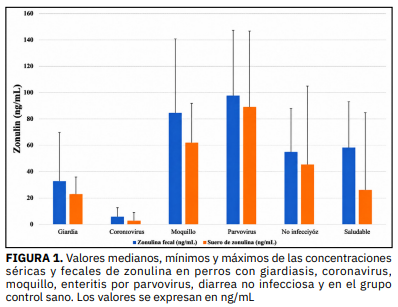
This study aimed to simultaneously determine zonulin levels in feces and blood as a reliable biomarker for the detection and severity of intestinal permeability (“leaky gut”), which may develop due to infectious or non-infectious diarrhea of various etiologies in dogs. Fifty-four dogs, 45 with gastroenteritis and 9 healthy controls, were presented to the clinic with a history of diarrhea lasting at least one day and were classified according to etiology based on clinical laboratory analyses. Zonulin levels were measured in blood and fecal samples using enzyme-linked immunosorbent assay. Significant differences in both serum and fecal zonulin levels were found between the healthy group and all diseased groups. Fecal zonulin levels in the diseased dogs differed significantly between the coronavirus group and the giardia and parvovirus groups, while serum zonulin levels also differed significantly in the distemper group. These findings suggest that fecal and serum zonulin levels may serve as non-invasive biomarkers of blood–brain barrier dysfunction in dogs with gastroenteritis.
Downloads
References
Candellone A, Cerquetella M, Girolami F, Badino P, Odore R. Acute diarrhea in dogs: Current management and potential role of dietary polyphenols supplementation. Antioxidants. [Internet]. 2020; 9(8):725. doi: https://doi.org/g5sg37 DOI: https://doi.org/10.3390/antiox9080725
Hubbard K, Skelly B, McKelvie J, Wood J. Risk of vomiting and diarrhoea in dogs. Vet. Rec. [Internet]. 2007; 161(22):755–757. doi: https://doi.org/d3f95s DOI: https://doi.org/10.1136/vr.161.22.755
Lenox CE. Nutritional management for dogs and cats with gastrointestinal diseases. Vet. Clin. North Am. Small. Anim. Pract. [Internet]. 2021; 51(3):669–684. doi: https://doi.org/rcrk DOI: https://doi.org/10.1016/j.cvsm.2021.01.006
Fasano A. Zonulin, regulation of tight junctions, and autoimmune diseases. Ann. N. Y. Acad. Sci. [Internet]. 2012; 1258(1):25–33. doi: https://doi.org/f36c2p DOI: https://doi.org/10.1111/j.1749-6632.2012.06538.x
Sapone A, de Magistris L, Pietzak M, Clemente MG, Tripathi A, Cucca F, Lampis R, Kryszak D, Cartenì M, Generoso M, Iafusco D, Prisco F, Laghi F, Riegler G, Carratu R, Counts D, Fasano A. Zonulin upregulation is associated with increased gut permeability in subjects with type 1 diabetes and their relatives. Diabetes. [Internet]. 2006; 55(5):1443–1449. doi: https://doi.org/b54jwn DOI: https://doi.org/10.2337/db05-1593
Fasano A. Regulation of intercellular tight junctions by zonula occludens toxin and its eukaryotic analogue zonulin. Ann. N. Y. Acad. Sci. [Internet]. 2000; 915(1):214–222. doi: https://doi.org/fr6vj DOI: https://doi.org/10.1111/j.1749-6632.2000.tb05244.x
Tripathi A, Lammers KM, Goldblum S, Shea-Donohue T, Netzel-Arnett S, Buzza MS, Antalis TM, Vogel SN, Zhao A, Yang S, Arrietta MC, Meddings JB, Fasano A. Identification of human zonulin, a physiological modulator of tight junctions, as prehaptoglobin-2. Proc. Natl. Acad. Sci. USA. [Internet]. 2009; 106(39):16799–16804. doi: https://doi.org/dhz4qn DOI: https://doi.org/10.1073/pnas.0906773106
El Asmar R, Panigrahi P, Bamford P, Berti I, Not T, Coppa GV, Catassi C, Fasano A. Host-dependent zonulin secretion causes impairment of the small intestinal barrier function after bacterial exposure. Gastroenterology. [Internet]. 2002; 123(5):1607–1615. doi: https://doi.org/d45fpm DOI: https://doi.org/10.1053/gast.2002.36578
Fasano A. Zonulin and its regulation of intestinal barrier function: The biological door to inflammation, autoimmunity, and cancer. Physiol. Rev. [Internet]. 2011; 91(1):151–175. doi: https://doi.org/d62qsb DOI: https://doi.org/10.1152/physrev.00003.2008
Sturgeon C, Fasano A. Zonulin, a regulator of epithelial and endothelial barrier functions, and its involvement in chronic inflammatory diseases. Tissue Barriers. [Internet]. 2016; 4(4):e1251384. doi: https://doi.org/rcrm DOI: https://doi.org/10.1080/21688370.2016.1251384
Miranda-Ribera A, Ennamorati M, Serena G, Cetinbas M, Lan J, Sadreyev RI, Jain N, Fasano A, Fiorentino M. Exploiting the zonulin mouse model to establish the role of primary impaired gut barrier function on microbiota composition and immune profiles. Front. Immunol. [Internet]. 2019; 10:2233. doi: https://doi.org/gk8btd DOI: https://doi.org/10.3389/fimmu.2019.02233
Szymanska E, Wierzbicka A, Dadalski M, Kierkus J. Fecal zonulin as a noninvasive biomarker of intestinal permeability in pediatric patients with inflammatory bowel diseases—correlation with disease activity and fecal calprotectin. J. Clin. Med. [Internet]. 2021; 10(17):3905. doi: https://doi.org/rcrp DOI: https://doi.org/10.3390/jcm10173905
Caviglia GP, Dughera F, Ribaldone DG, Rosso C, Abate ML, Pellicano R, Smedile A, Saracco M, Astegiano M. Serum zonulin in patients with inflammatory bowel disease: A pilot study. Minerva Med. [Internet]. 2019; 110(2):95–100. doi: https://doi.org/gh8tcd DOI: https://doi.org/10.23736/S0026-4806.18.05787-7
Vanuytsel T, Vermeire S, Cleynen I. The role of haptoglobin and its related protein, zonulin, in inflammatory bowel disease. Tissue Barriers. [Internet]. 2013; 1(5):e27321. doi: https://doi.org/rcrq DOI: https://doi.org/10.4161/tisb.27321
Malícková K, Francová I, Lukáš M, Kolár M, Králíková E, Bortlík M, Duricová D, Štepánková L, Zvolská K, Pánková A, Zima T. Fecal zonulin is elevated in Crohn’s disease and in cigarette smokers. Pract. Lab. Med. [Internet]. 2017; 9:39–44. doi: https://doi.org/gb4wgj DOI: https://doi.org/10.1016/j.plabm.2017.09.001
Dinesh N, Slovak JE, Kogan C, Kopper JJ. Preliminary evaluation of serum zonulin in canine chronic enteropathies. J. Small Anim. Pract. [Internet]. 2022; 63(9):679–685. doi: https://doi.org/rcrs DOI: https://doi.org/10.1111/jsap.13506
Rossi G, Gavazza A, Vincenzetti S, Mangiaterra S, Galosi L, Marchegiani A, Pengo G, Sagratini G, Ricciutelli M, Cerquetella M. Clinicopathological and fecal proteome evaluations in dogs with chronic diarrhea associated with lymphangiectasia. Vet. Sci. [Internet]. 2021; 8(10):242. doi: https://doi.org/rcrt DOI: https://doi.org/10.3390/vetsci8100242
Giron LB, Dweep H, Yin X, Wang H, Damra M, Goldman AR, Gorman N, Palmer CS, Tang HY, Shaikh MW, Forsyth CB, Balk RA, Zilberstein NF, Liu Q, Kossenkov A, Keshavarzian A, Landay A, Abdel-Mohsen M. Plasma markers of disrupted gut permeability in severe COVID-19 patients. Front. Immunol. [Internet]. 2021; 12:686240. doi: https://doi.org/gkgzg8 DOI: https://doi.org/10.3389/fimmu.2021.686240
Oliva A, Cammisotto V, Cangemi R, Ferro D, Miele MC, De Angelis M, Cancelli F, Pignatelli P, Venditti M, Pugliese F, Mastroianni CM, Violi F. Low-grade endotoxemia and thrombosis in COVID-19. Clin. Transl. Gastroenterol. [Internet]. 2021; 12(6):e00348. doi: https://doi.org/gkfz9r DOI: https://doi.org/10.14309/ctg.0000000000000348
Çöllü EM, Özalp T, Erdogan S, Ural K, Erdogan H. Investigation of zonulin levels in dogs infected with canine distemper virus. Bozok. Vet. Sci. [Internet]. 2024; 5(2):55–61. doi: https://doi.org/rcrv DOI: https://doi.org/10.58833/bozokvetsci.1545898
Fasano A. Physiological, pathological, and therapeutic implications of zonulin-mediated intestinal barrier modulation: Living life on the edge of the wall. Am. J. Pathol. [Internet]. 2008; 173(5):1243–1252. doi: https://doi.org/b5bwnr DOI: https://doi.org/10.2353/ajpath.2008.080192