Ethnomelissological, melissopalynological and physicochemical characterization of honeys from the El Tarf region, Northeastern Algeria
Abstract
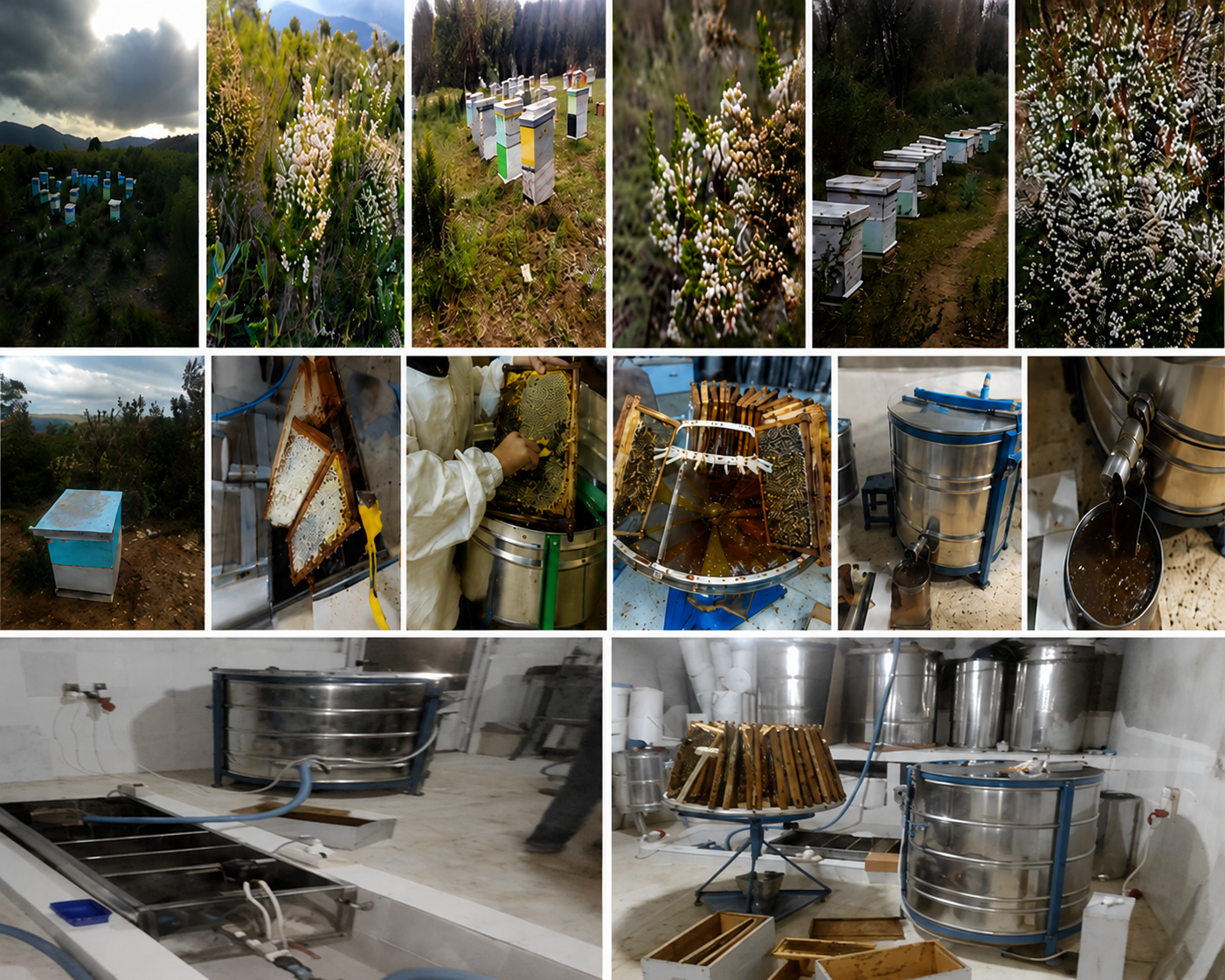
Honey is a natural product produced by bees from floral nectar or plant secretions. This study evaluated apicultural practices and honey quality from the El Tarf region (northeastern Algeria) using an integrated approach combining ethnomellissological surveys, melissopalynological analysis, and physicochemical characterization. A total of 36 samples representing six honey types (white heather, eucalyptus, lavender, mountain, multifloral, and orange blossom) were collected from four localities (Aïn Khiyar, Zitouna, Bougous, and Aïn Karma). Pollen analysis revealed a predominance of polyfloral honeys with variable monofloral representation. Physicochemical parameters showed significant variability among honey types (p < 0.05), with pH ranging from 3.73 to 4.37, moisture content from 13.90 % to 18.19 %, and electrical conductivity from 330.33 to 719.33 µS.cm-1. Hydroxymethylfurfural (HMF) content varied between 41.35 and 49.80 mg.kg-1, while total acidity ranged from 41.50 to 63.64 meq.kg-1. Diastase activity (9.50–14.00 DN) and proline content (310–420 mg.kg-1) also showed significant differences according to botanical origin (p < 0.05). All samples complied with international honey quality standards. Principal Component Analysis (PCA) showed that honey samples were clearly structured according to botanical origin, with electrical conductivity, proline, and acidity contributing most to variability (PC1 = 46.38 %, PC2 = 28.04 %). Monofloral honeys exhibited more homogeneous profiles, whereas multifloral samples were more dispersed, confirming significant compositional variability (p < 0.05). The results demonstrate that honey quality in the El Tarf region is primarily influenced by floral origin and local beekeeping practices, highlighting the relevance of integrating traditional knowledge with physicochemical and palynological approaches for honey authentication and quality assessment.
Downloads
References
Food Chemistry, 135(3), 1448–1454. https://doi.org/10.1016/j.foodchem.2012.06.012
Al-Kafaween, M. A., Alwahsh, M., Hilmi, A. B. M., & Abulebdah, D. H. (2023).
Physicochemical characteristics and bioactive compounds of different types of honey and their biological and therapeutic properties: A comprehensive review.
Antibiotics (Basel), 12(2), 337. https://doi.org/10.3390/antibiotics12020337
Amessis-Ouchemoukh, N., Maouche, N., Otmani, A., Terrab, A., Madani, K., & Ouchemoukh, S. (2021). Evaluation of Algerian’s honey in terms of quality and authenticity based on melissopalynology, physicochemical analysis, and antioxidant power. Mediterranean Journal of Nutrition and Metabolism, 14(3), 305–324.
https://doi.org/10.3233/MNM-210561
Anjos O, Seixas, N., Antunes, C. A. L., Campos, M. G., Paula, V., & Estevinho LM (2023). Quality of bee pollen submitted to drying, pasteurization, and high-pressure processing A comparative approach. Food Research International, 170, 112964.
https://doi.org/10.1016/j.foodres.2023.112964
Anjos, O.; Campos, M. G.; Contreras Ruiz, P.; & Antunes, P. (2015).
Application of FTIR-ATR spectroscopy to the quantification of sugar in honey.
Food Chemistry, 169, 218–223. https://doi.org/10.1016/j.foodchem.2014.07.138
Ayad, R., Amessis-Ouchemoukh, N., Ouchemoukh, S., Madani, K., & Boulekbache-Makhlouf, L. (2021). Pollen profiles, physicochemical characteristics, and antioxidant activities of honey from Jijel City (Algérie). Annals of University Dunarea de Jos of Galati. Food Technology, 45(2), 147–167. https://doi.org/10.35219/foodtechnology.2021.2.10
Bouddine, T., Kachmar, M. R., Akdad, M., Bouymajane, A., Ajebli, M., & Mothana, R. (2024). Authentication of Ziziphus lotus Honey from the Middle Atlas Mountains of Morocco: Physicochemical Properties, Mineral Content, Sugar, Polyphenol Profiles, and Antioxidant Capacity. ACS Omega, 9(45), 44956–44973. https://doi.org/10.1021/acsomega.4c04284.
Boussaid, A., Chouaibi, M., Rezig, L., Hellal, R., Donsì, F., Ferrari, G., & Hamdi, S. (2018). Physicochemical and bioactive properties of six honey samples from various floral origins from Tunisia. Arabian Journal of Chemistry, 11(2), 265–274.
https://doi.org/10.1016/j.arabjc.2014.08.011
Boutabia L., Telailia S. & Chefrour A. (2016). Spectre pollinique de miels d'abeille (Apis mellifera L.) de la région d'El Tarf (Nord-Est algérien). Livestock Research for Rural Development, 28(8). https://www.lrrd.org/lrrd28/8/tela28150.html
Codex Alimentarius Commission (2001). Standard for Honey (CODEX STAN 12-1981. Rev. 2-2001).
Cohen, H., Ponisio, L. C., Russell, K. A., Philpott, S. M., & McFrederick, Q. S. (2022). Floral resources shape parasite and pathogen dynamics in bees facing urbanization. Molecular Ecology, 31(7), 1964–1977. https://doi.org/10.1111/mec.16374
Da Silva, P.M., Gauche, C., Gonzaga, L.V., Costa, A.C.O., & Fett, R. (2016). Honey: Chemical composition, stability and authenticity. Food Chemistry, 196, 309–323. https://doi.org/10.1016/j.foodchem.2015.09.051
Derrar, S., Lo Turco, V., Albergamo, A., Sgrò, B., Ayad, M. A., Litrenta, F., Saim, M. S., Potortì, A. G., Aggad, H., Rando, R. & Di Bella, G. (2024).
Study of physicochemical quality and organic contamination in Algerian honey.
Foods, 13(9), 1413.https://doi.org/10.3390/foods13091413
Gheldof, N., Wang, X.-H., & Engeseth, N. J. (2002). Identification and quantification of antioxidant components of honeys from various floral sources. Journal of Agricultural and Food Chemistry, 50(21), 5870–5877. https://doi.org/10.1021/jf0256135
Ghorab, A., Rodríguez-Flores, M. S., Nakib, R., Escuredo, O., Haderbache, L., Bekdouche, F., & Seijo, M. C. (2021). Sensorial, melissopalynological and physico-chemical characteristics of honey from Babors Kabylia’s region (Algeria). Foods, 10(2), 225. https://doi.org/10.3390/foods10020225
Haderbache, L., & Mohammedi, A. (2015). Quality of imported honeys marketed in Algeria: Physicochemical, labeling and pollen analysis. Journal of Fundamental and Applied Sciences, 7(1), 139–149. https://doi.org/10.4314/jfas.v7i1.10
Hamsas El Youbi, A., Ouahidi, I., El Mansouri, L., Daoudi, A., & Bousta, D. (2016). Ethnopharmacological survey of plants used for immunological diseases in four regions of Morocco. European Journal of Medicinal Plants, 13(1), 1–24.
https://doi.org/10.9734/EJMP/2016/12946
Khalil, M. I., Moniruzzaman, M., Boukraâ, L., Benhanifia, M., Islam, M. A., Islam, M. N., Sulaiman, S. A., & Gan, S. H. (2012). Physicochemical and antioxidant properties of Algerian honey. Molecules, 17(9), 11199–11215. https://doi.org/10.3390/molecules170911199
Ketfi, L., Draiaia, R., Necib, A., & Mohamadi, N. (2023). Physicochemical and melissopalynological study of some honey samples from the Algerian East Region. Turkish Journal of Agriculture-Food Science and Technology, 11(4), 780-784. https://doi.org/10.24925/turjaf.v11i4.780-784.5941.
Louveaux, J., Maurizio, A., & Vorwohl, G. (1978). Methods of melissopalynology. Bee World, 59(4), 139–157. https://doi.org/10.1080/0005772X.1978.11097714.
Machado De-Melo, A. A., Almeida-Muradian, L. B. de, Sancho, M. T., & Pascual-Maté, A. (2018). Composition and properties of Apis mellifera honey: A review.
Journal of Apicultural Research, 57(1), 5–37. https://doi.org/10.1080/00218839.2017.1338444
Copyright (c) 2026 Amira Bergal, Warda Boumaraf, Loubna Nefla, Chahrazed Bouksiba, Djamel Eddine Benouareth

This work is licensed under a Creative Commons Attribution-NonCommercial-ShareAlike 4.0 International License.