Physiological and biochemical responses of drought-acclimated Pistacia atlantica Desf. to short-term irrigation
Abstract
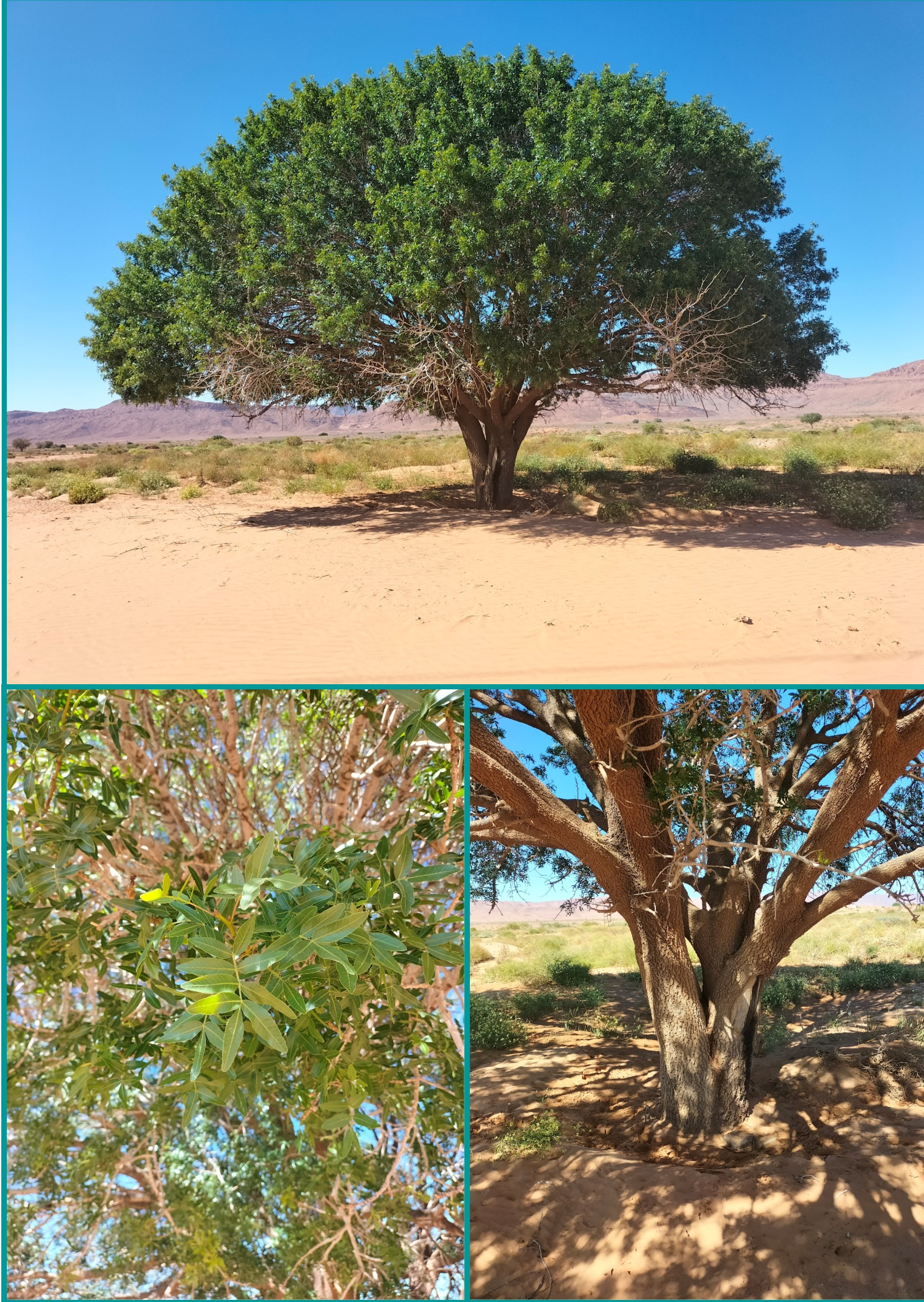
Pistacia atlantica Desf. is a key drought-tolerant tree in hyper-arid North African ecosystems, yet little is known about how its osmolytes and phenolic-based antioxidant system respond when water availability is transiently improved. This study evaluated the short-term effects of irrigation on osmolyte levels, phenolic composition, and antioxidant activity in drought-acclimated P. atlantica trees. Ten adult trees in Igli region (southwestern Algeria) were assigned to non-irrigated and irrigated groups. Leaves were sampled before and after 90 days of irrigation. The relatively small sample size reflects the limited number of trees available and suitable for the study criteria in the area. Relative water content, proline, glycine betaine, total phenolics, and individual phenolics (HPLC-DAD) were determined. Results showed that irrigation increased leaf water content by about 12 % and significantly reduced proline (−25 %), glycine betaine (−22 %), and total phenolics (−30 %), while IC50 increased by 25 %. All quantified phenolics decreased after irrigation, with maximum reductions of −24 to −27 % were observed for chlorogenic, ferulic, and p-coumaric acids and quercetin, whereas gallic, syringic, ellagic acids and naringenin showed smaller declines (−8 to −16 %). The close coupling between osmolytes, key hydroxycinnamic acids and flavonols, and antioxidant activity indicates an integrated defence network that is highly sensitive to water availability and central to drought resistance and recovery in this species.
Downloads
References
Algeomap. (2025). https://algeomap.rf.gd/?i=1. Accessed October 15, 2025.
Ashraf, M., & Foolad, M. R. (2007). Roles of glycine betaine and proline in improving plant abiotic stress resistance. Environmental and Experimental Botany, 59(2), 206–216. https://doi.org/10.1016/j.envexpbot.2005.12.006
Bates, L. S., Waldren, R. P., & Teare, I. D. (1973). Rapid determination of free proline for water-stress studies. Plant and Soil, 39(1), 205–207. https://doi.org/10.1007/BF00018060
Belaid, S., Nouri, T., & Benaradj, A. (2024). Therapeutic properties of the Atlas pistachio tree (Pistacia atlantica Desf.) in the Naâma region (Algeria). Biodiversity: Research and Conservation, 76(2), 39–49. https://doi.org/10.14746/biorc.2024.76.1
Bendeddouche, Z. F., Benhassaini, H., Bellatreche, M., & Belkhodja, M. (2025). Biochemical Responses of Pistacia atlantica Desf. subsP. atlantica (Anacardiaceae) Seedlings Under Saline Stress: Accumulation of Osmolytes and Antioxidants in Controlled Conditions. Journal of Applied Bioanalysis, 11(2), 162–174. https://doi.org/10.53555/jab.v11i2.196
Benmahieddine, A., Belyagoubi-Benhammou, N., Belyagoubi, L., Amari, N. O., Zerey-Belaskri, A. El, Gismondi, A., Di Marco, G., Canini, A., Habi, S., Atik Bekkara, F., & Djebli, N. (2023). Leaf-buds of Pistacia atlantica: a novel source of bioactive molecules with high anti-inflammatory, antioxidant, anti-tyrosinase and antimicrobial properties. Physiology and Molecular Biology of Plants, 29(2), 209–219. https://doi.org/10.1007/s12298-023-01290-z
Chelghoum, M., Guenane, H., Tahri, D., Laggoun, I., Marfoua, F. Z., Rahmani, F. Z., Khenifer, F., & Yousfi, M. (2021). Influence of altitude, precipitation, and temperature factors on the phytoconstituents, antioxidant, and α-amylase inhibitory activities of Pistacia atlantica. Journal of Food Measurement and Characterization, 15(5), 4411–4425. https://doi.org/10.1007/s11694-021-01006-5
Djoudi, W., Youb, O., Bouarfa, S., & Amara, K. (2024). Economic and social characteristics of desert agriculture in arid regions: a typological review of the Beni Abbes area in south-west Algeria. Brazilian Journal of Animal and Environmental Research, 7(4), e76067–e76067. https://doi.org/10.34188/bjaerv7n4-142
Doghbage, A., Belhadj, S., Boukerker, H., Mevy, J. P., Gauquelin, T., Tonetto, A., Habib, B., Derridj, A., Bouabdelli, Z. R., Soufan, W., & Belhouadjeb, F. A. (2024). Effect of Ecotype and Gender on the Variation of Leaf Morphological, Epidermal and Stomatal Traits among Pistacia atlantica Desf. Phyton, 93(9), 2383–2413. https://doi.org/10.32604/phyton.2024.055528
Grieve, C. M., & Grattan, S. R. (1983). Rapid assay for determination of water soluble quaternary ammonium compounds. Plant and Soil, 70(2), 303–307. https://doi.org/10.1007/BF02374789
Hamitouche, Y., Zeroual, A., Meddi, M., Assani, A. A., Alkama, R., Şen, Z., & Zhang, X. (2024). Projected Changes in Extreme Precipitation Patterns across Algerian Sub-Regions. Water, 16(10), 1353. https://doi.org/10.3390/w16101353
IBM SPSS Statistics. (2020). https://www.ibm.com/products/spss-statistics
Ifticene-Habani, N., Camarero, J. J., & Abdoun, F. (2025). Growth rates and responses to climate and aridity of Algerian Atlas pistachio populations. Dendrochronologia, 91, 126326. https://doi.org/10.1016/j.dendro.2025.126326
Kadoma, Y., & Fujisawa, S. (2008). A Comparative Study of the Radical-scavenging Activity of the Phenolcarboxylic Acids Caffeic Acid, p-Coumaric Acid, Chlorogenic Acid and Ferulic Acid, With or Without 2-Mercaptoethanol, a Thiol, Using the Induction Period Method. Molecules, 13(10), 2488–2499. https://doi.org/10.3390/molecules13102488
La, V. H., Tran, D. H., Han, V., Nguyen, T. D., Duong, V. C., Nguyen, V. H., Tran, A. T., Nguyen, T. H. G., & Ngo, X. B. (2023). Drought stress‐responsive abscisic acid and salicylic acid crosstalk with the phenylpropanoid pathway in soybean seeds. Physiologia Plantarum, 175(5). https://doi.org/10.1111/ppl.14050
Mohammadi, B., Maboud, H. E., & Seyedi, S. M. (2023). Evaluation of Two Arms of Antioxidant Machineries in Pistacia atlantica and Pistacia khinjuk under Different Climatic Conditions. Russian Journal of Plant Physiology, 70(3), 42. https://doi.org/10.1134/S1021443722602427
Nasa Power, D. (2025). NASA POWER Data Access Viewer (DAV). Https://Power.Larc.Nasa.Gov/Data-Access-Viewer/.
Razzaghi-Asl, N., Garrido, J., Khazraei, H., Borges, F., & Firuzi, O. (2013). Antioxidant Properties of Hydroxycinnamic Acids: A Review of Structure- Activity Relationships. Current Medicinal Chemistry, 20(36), 4436–4450. https://doi.org/10.2174/09298673113209990141
Singleton, V. L., & Rossi, J. A. (1965). Colorimetry of Total Phenolics with Phosphomolybdic-Phosphotungstic Acid Reagents. American Journal of Enology and Viticulture, 16(3), 144–158. https://doi.org/10.5344/ajev.1965.16.3.144
Skroza, D., Šimat, V., Vrdoljak, L., Jolić, N., Skelin, A., Čagalj, M., Frleta, R., & Generalić Mekinić, I. (2022). Investigation of Antioxidant Synergisms and Antagonisms among Phenolic Acids in the Model Matrices Using FRAP and ORAC Methods. Antioxidants, 11(9), 1784. https://doi.org/10.3390/antiox11091784
Smart, R. E., & Bingham, G. E. (1974). Rapid Estimates of Relative Water Content. Plant Physiology, 53(2), 258–260. https://doi.org/10.1104/pp.53.2.258
Toul, F., Belyagoubi-Benhammou, N., Zitouni, A., & Atik-Bekkara, F. (2017). Antioxidant activity and phenolic profile of different organs of Pistacia atlantica Desf. subsp. atlantica from Algeria. Natural Product Research, 31(6), 718–723. https://doi.org/10.1080/14786419.2016.1217205
Toul, F., Moussouni, S., Ghembaza, N., Zitouni, A., Djendar, A., Atik-Bekkara, F., & Kokkalou, E. (2022). Identification of phenolic compounds in the buds of Algerian Pistacia atlantica desf. Subsp. atlantica by antioxidant activity guided fractionation. Journal of Complementary & Integrative Medicine, 19(2), 219–224. https://doi.org/10.1515/jcim-2021-0336
Uzilday, B., Takahashi, K., Kobayashi, A., Uzilday, R. O., Fujii, N., Takahashi, H., & Turkan, I. (2024). Role of Abscisic Acid, Reactive Oxygen Species, and Ca2+ Signaling in Hydrotropism—Drought Avoidance-Associated Response of Roots. Plants, 13(9), 1220. https://doi.org/10.3390/plants13091220
Walfish, S. (2006). Analytical methods: a statistical perspective on the ICH Q2A and Q2B guidelines for validation of analytical methods. BioPharm International, 19(12), 1–6.
Wani, A. W., Kaur, H., Verma, P., Kumar, S., Ravi, K., Mirza, A. A., Rahim, A., Gani, I., Zarina, & Zimare, S. B. (2024). Phenolic Compounds in Plants. In Plant Secondary Metabolites and Abiotic Stress (pp. 349–388). Wiley. https://doi.org/10.1002/9781394186457.ch13
Zhao, B. T., Jeong, S. Y., Kim, T. I., Seo, E. K., Min, B. S., Son, J. K., & Woo, M. H. (2015). Simultaneous quantitation and validation of method for the quality evaluation of Eucommiae cortex by HPLC/UV. Archives of Pharmacal Research, 38(12), 2183–2192. https://doi.org/10.1007/s12272-015-0642-3
Copyright (c) 2026 Fethi Toul, Bouziane Terfaya, Abdelkader Guenaia

This work is licensed under a Creative Commons Attribution-NonCommercial-ShareAlike 4.0 International License.